
Facebook vs. Google Ads: Which Works Best for Small Businesses?
- Rafael Ch
- Jun 3, 2025
- 6 min read

Updated: Jun 8, 2025
1. Introduction
Paid advertising remains a cornerstone of any successful small business marketing strategy. However, knowing where to invest your limited ad budget can be challenging. Two of the most widely used platforms are Facebook (Meta) Ads and Google Ads. In this post, we’ll break down the differences between Meta ads vs Google ads, explore their strengths and weaknesses, and provide actionable guidance to help your Houston-based small business decide which platform is the best fit.

2. Understanding the Basics
2.1. Google Ads (Search & Display Network)
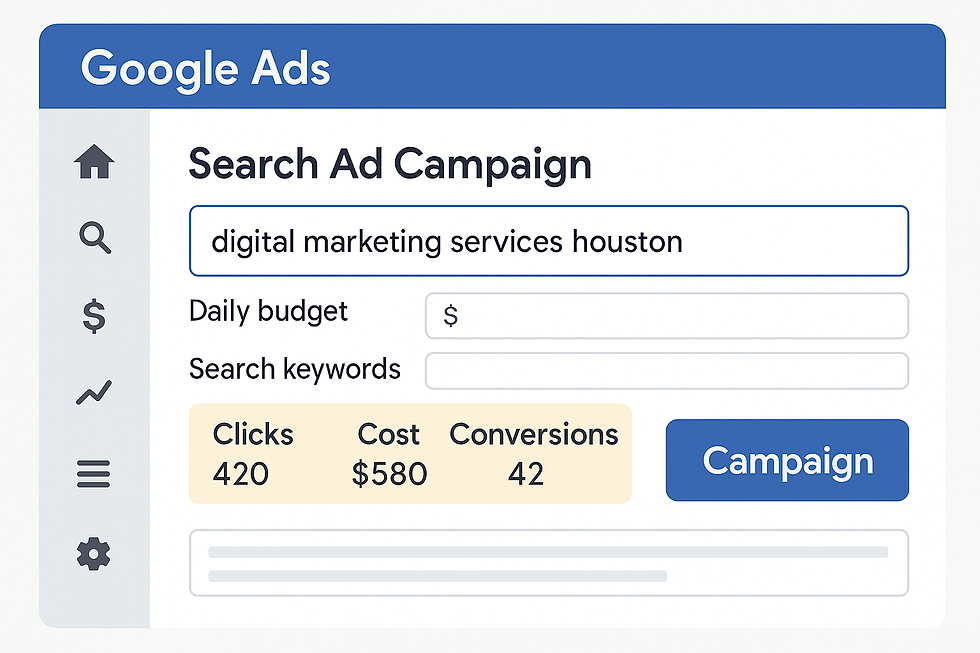
Search Ads: Appear at the top of Google search results when users enter keywords related to your business (e.g., “digital marketing services Houston” or “coffee shop near me”).
Display Ads: Banner-style ads shown on websites, apps, and YouTube through Google’s Display Network, targeting users by interests, topics, or remarketing to previous visitors.
2.2. Meta Ads (Facebook & Instagram)
Feed & Story Ads: Image, video, carousel, and collection formats served within Facebook and Instagram feeds, Stories, and the Audience Network.
Audience Targeting: Leverages demographic, interest, and behavior data—allowing for granular targeting (e.g., “Small business owners in Houston interested in SEO”).
Placement Options: Includes Facebook News Feed, Instagram Feed, Marketplace, Messenger, and third-party apps within the Meta Audience Network.
3. Key Differences: Meta Ads vs Google Ads
Aspect | Google Ads | Meta Ads (Facebook & Instagram) |
Intent vs. Interest | High-intent search: reach users actively searching for your product/service. | Interest-based: reach users based on interests, demographics, and behaviors. |
Network Reach | Search Network + Display Network (millions of websites, apps, YouTube). | Facebook family of apps (Facebook, Instagram, Messenger) and Audience Network. |
Ad Formats | Text ads (Search), image banners, video, responsive display, YouTube. | Image, video, carousel, collection, Stories, Reels. |
Cost Model | Pay-per-click (CPC) or cost per thousand impressions (CPM); average CPCs in the U.S. range $1–$2 for search.¹ | Primarily CPM and CPC; average CPCs range $0.50–$90 depending on targeting.² |
Targeting Options | Keywords, location, device, remarketing lists, custom intent audiences. | Demographics, interests, behaviors, custom audiences (email lists, website visitors). |
Best for… | Capturing demand from users ready to purchase or inquire. | Building brand awareness, engaging new audiences, and retargeting warm leads. |
¹Source: WordStream, “Google Ads Benchmarks for 2024.”²Source: Meta Business Help Center, “Meta Ads Cost Overview,” 2024.
4. Pros & Cons for Small Businesses
4.1. Google Ads
Pros
High Intent Traffic: Users search with specific needs—“plumber Houston TX” or “affordable web design Houston”—yielding higher conversion rates.
Immediate Visibility: Paid search ads appear at the top of search results within minutes of campaign launch, ideal for time-sensitive promotions.
Transparent Performance Metrics: Easily track impressions, clicks, cost per conversion, and ROI via Google Ads and Google Analytics integration.
Cons
Higher Cost per Click (CPC): Competitive keywords can drive CPCs above $2–$5 in industries like legal services, real estate, and digital marketing.
Keyword Management: Requires ongoing keyword research, negative keyword lists, and bid optimizations to prevent budget wastage.
Limited Visual Creativity: Search ads are text-based; display ads require design assets and consistent branding across multiple sizes.
4.2. Meta Ads
Pros
Advanced Audience Segmentation: Reach hyper-specific audiences—e.g., “Houston homeowners interested in interior design”—even before they actively search for your service.
Versatile Ad Formats: Use immersive video, carousel, or Stories to showcase products, drive engagement, and tell a brand story creatively.
Cost-Effective Awareness: Often lower CPC ($0.50–$1.50) for broad awareness or engagement campaigns, making it accessible for small budgets.
Cons
Lower Conversion Intent: Users scroll through social feeds for entertainment; they’re less likely to convert immediately compared to searchers on Google.
Ad Fatigue & Scroll Culture: Competing for attention in a crowded feed requires strong visuals and copy; users can scroll past your ad quickly.
Frequent Creative Refreshes: To combat “ad fatigue,” you’ll need to rotate creatives regularly (every 7–14 days) to maintain engagement and performance.
5. Which Platform Should Your Small Business Use?

5.1. Consider Your Objectives
Lead Generation & Immediate Sales: If your goal is to capture users actively searching for services (e.g., “mechanic near me,” “Houston flower delivery”), prioritize Google Ads search campaigns with location targeting.
Brand Awareness & Engagement: If you want to introduce your brand to a new audience or retarget website visitors who didn’t convert, Meta Ads (Facebook & Instagram) can effectively build top-of-funnel awareness and drive engagement.
5.2. Budget and Testing Strategy
Start Small & Test:
Allocate 60% to Google Ads and 40% to Meta Ads for initial testing—run campaigns simultaneously for 30 days to compare performance (CPC, click-through rate, conversion rate).
Example budget for Houston small businesses: $500/month total—$300 on Google Search, $200 on Facebook/Instagram.
Define Clear KPIs:
Google Ads KPIs: Cost per conversion, conversion rate, quality score (aim above 7).
Meta Ads KPIs: Cost per click, engagement rate (2–3%+ is strong), Cost per lead (CPL).
Analyze & Pivot:
If Google Ads yields a $25 CPL but Meta Ads CPL is $10 (for lead generation), consider shifting more budget to Meta campaigns.
Conversely, if Meta Ads achieve low engagement (<1%) and Google Ads drive immediate sign-ups, reallocate budget accordingly.
5.3. Hybrid Approach for Maximum Impact
Combined Funnel Strategy:
Top-of-Funnel (Awareness): Run Meta Ads to generate interest—use video or carousel ads targeting “Houston small business owners” with a free resource (e.g., “Download our Houston Marketing Checklist”).
Mid-Funnel (Consideration): Retarget these engaged users on Facebook/Instagram with testimonials or case studies.
Bottom-of-Funnel (Conversion): Use Google Search Ads for high-intent keywords (e.g., “Houston digital marketing agency”) to capture users ready to buy.
This funnel approach leverages Meta ads vs Google ads in tandem—building brand awareness first on social, then capturing demand on search.
6. Real-World Example: A Houston Café Case Study
Objective: Increase weekday lunch orders by 20% over three months.
Budget: $800/month total.
Campaign Breakdown:
Meta Ads (45% of Budget, $360):
Audience: Houston residents within a 5-mile radius, ages 25–55, interested in “coffee,” “freelancing,” “coworking.”
Ad Format: Carousel ad showcasing best-selling sandwiches and latte art, with a “Order Now” CTA linking to the café’s online menu.
Result: 5,000 reach, 500 post engagements, Cost per Engagement (CPE) $0.12.
Google Search Ads (55% of Budget, $440):
Keywords: “coffee shop near me,” “best lunch spots Houston,” “Houston café open now.”
Ad Copy: Highlight “Fresh Sandwiches & Specialty Coffee – Order Online for Pickup” with sitelinks to menu, location, and online ordering page.
Result: 1,200 clicks at $0.80 CPC, 150 online orders (12.5% conversion rate), Cost per Conversion $2.93.
Outcome:
Lunch orders increased by 23% over the quarter.
Meta Ads built buzz and drove foot traffic, while Google Ads captured high-intent users searching for “lunch near me.”
Combined approach led to a 30% boost in overall revenue during weekdays.
7. Budget Allocation Checklist for Houston Small Businesses
Define Monthly Ad Budget: Base on total marketing spend (e.g., 10% of revenue).
Decide Initial Split (Google vs Meta):
Recommendation: 60% Google Ads, 40% Meta Ads for most service-based small businesses.
Adjust over time based on performance data (e.g., shift to 50/50 or 40/60 if Meta CPL is lower).
Allocate to Campaign Types:
Search Campaigns: High-intent keywords (Google Search) – 70% of Google budget.
Display/Video/Bumper (YouTube): Brand awareness – 30% of Google budget.
Meta Feed Ads: Image, video, carousel – 70% of Meta budget.
Meta Retargeting Ads: Retarget website visitors – 30% of Meta budget.
Set Daily Budgets & Bid Strategies:
Google Ads: Use “Maximize Conversions” or “Target CPA” once you have at least 15 conversions in 30 days.
Meta Ads: Use “Lowest Cost” bidding for awareness; switch to “Cost Cap” for lead-gen once CPL targets are known.
8. Measuring Success & Iteration
8.1. Essential Metrics to Track
Google Ads Metrics:
Click-Through Rate (CTR): Aim for 2%+ on search ads.
Conversion Rate: Aim for 5%+ on service-based keywords.
Cost per Acquisition (CPA): Keep below your target (e.g., $25 per new lead).
Meta Ads Metrics:
Engagement Rate: Aim for 2%–3%+ across feed and Stories.
Cost per Lead (CPL): Benchmark $5–$15 for small B2C businesses in Houston.
Frequency: Keep between 1.5–2 to avoid ad fatigue (the average user sees your ad 1.5–2 times per week).
8.2. A/B Testing & Optimization
Ad Creative & Copy:
Test different headlines, images, and CTAs—rotate every 7–10 days for Meta Ads.
For Google Ads, test at least 2–3 ad variations per ad group with different calls-to-action and sitelinks.
Audience Segments:
On Meta, create lookalike audiences based on your top 5% of customers, and compare performance to interest-based audiences.
On Google, experiment with similar audiences (users with analogous search behavior) and remarketing lists.
Time of Day & Day of Week:
Review hourly and daily performance reports—shift budgets to peak times (e.g., lunchtime for a café, weekday mornings for a service business).
8.3. Quarterly Performance Review
Compile a combined report detailing:
Total ad spend vs. conversions and ROI.
Keyword performance shifts (Google) and audience engagement trends (Meta).
Recommendations for the next quarter (e.g., increase Google budget by 10% for high-performing keywords, allocate additional 5% to Facebook retargeting).
Ready to find the perfect blend of Meta ads vs Google ads for your small business? Schedule a free ad strategy session with DIstrategiesM. We’ll analyze your goals, budget, and audience to craft a customized ad plan that drives qualified leads and revenue growth.


Comments